
How I Finally Got Rid of Pantry Moths!
 If you’re reading this, chances are you’ve had that awful moment: you open your pantry and a tiny moth flutters out.
And if you’ve already cleaned everything, thrown away food, set out pantry moth traps—and then watched another moth appear a few days later—you know how frustrating a pantry moth infestation can be.
That was exactly what happened to me.
I cleaned. I threw food away. I scrubbed shelves. I tried pantry moth traps and even bug sprays I really didn’t want anywhere near my kitchen.
And the moths kept coming back.
What finally changed things was realizing that getting rid of the moths I could see wasn’t enough. I had to deal with the food sources, hidden eggs and larvae, tiny hiding places, and the pantry moth life cycle.
Two products that became important in my fight were food-grade Diatomaceous Earth (DE) and Boric Acid.
But there was an even bigger lesson:
The products alone aren’t the solution. You need a plan for finding the source, cleaning the right places, protecting your food, and knowing what to do when another moth appears.
Still Seeing Pantry Moths After You’ve Cleaned?
If you’re in the middle of an infestation and don’t want to piece together dozens of tips while your pantry is sitting all over your kitchen, I turned everything I learned into one step-by-step system.
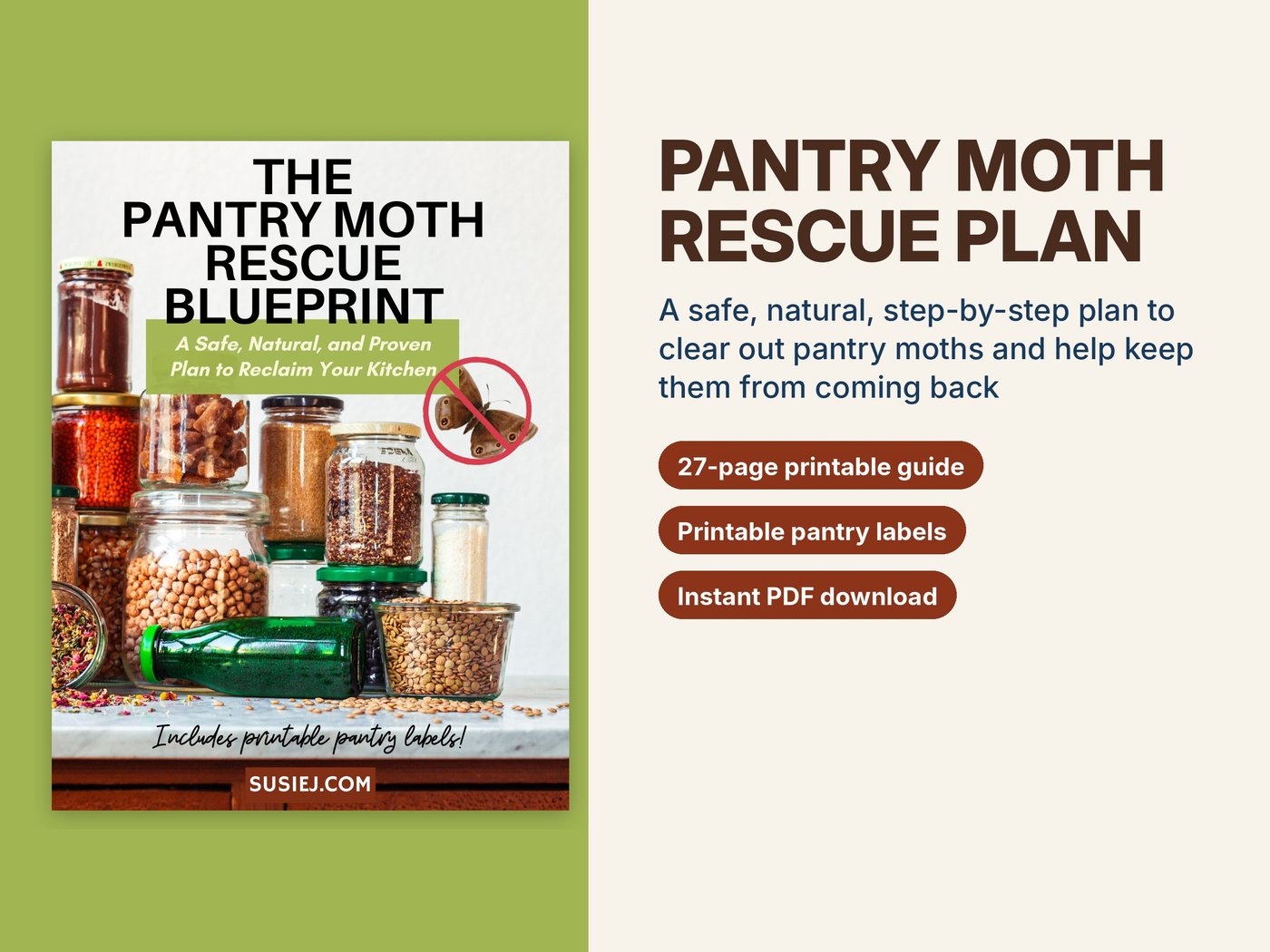
The Pantry Moth Rescue Blueprint
A step-by-step plan for taking back your pantry—plus the troubleshooting system for what to do if the moths keep coming back.
Inside you’ll get:
- Printable Action Checklist
- Day 1: Purge + Deep Clean Plan
- Day 2: Seal + Defend Plan
- “What Do I Do If…?” Troubleshooting Guide
- Emergency “I Can’t Find the Source” Plan
- Hidden pantry moth hotspot guide
- Long-term prevention system
- Complete supply list
- Printable pantry + freezer labels
Instead of wondering what to clean next, you’ll know exactly what to do and in what order.
Get the Pantry Moth Rescue Blueprint — $7.99
Digital download. Get immediate access and start the plan today.
Why Are Pantry Moths So Hard to Get Rid Of?
The biggest mistake I made at first was thinking that the moth flying around my kitchen was the problem.
It wasn’t.
An adult moth is simply the part of the infestation you can see.
Pantry moths can be associated with dry foods such as flour, grains, cereal, nuts, seeds, dried fruit, spices and pet food. And once larvae leave a food source, they can end up in small protected areas around your pantry and kitchen.
That’s why you can throw away the obvious contaminated package, clean the shelf, and still see another moth later.
You aren’t just looking for adult moths. You’re looking for the source of the infestation and evidence that the life cycle is continuing.
What Do Pantry Moths Look Like in Your Food?
Start by inspecting vulnerable dry goods carefully.
Look for things such as:
- Silky webbing inside or around food packages
- Small larvae
- Food that appears unusually clumped together
- Webbing around folds and package seams
- Cocoons or larvae around protected cracks and corners
Pay particular attention to flour, cereal, grains, rice, pasta, nuts, seeds, dried fruit, baking ingredients, spices, pet food and bird seed.
And don’t assume finding one contaminated package means you’ve found the entire problem.
The Pantry Moth Products That Helped Me
You don’t need a cabinet full of pesticides to fight pantry moths. These are the basic products and supplies I found most useful.
- Food-Grade Diatomaceous Earth (DE)
- Boric Acid
- Pantry Moth Traps
- Airtight Glass Containers
- Vacuum + ordinary cleaning supplies
You can also see my complete pantry moth product checklist here:
See My Pantry Moth Product Checklist →
Important: Always read and follow the manufacturer’s label and safety directions for pest-control products. Avoid breathing dust from products such as DE, and don’t apply pest-control products directly to exposed food or food-preparation surfaces unless the product label specifically permits that use. Keep products appropriately stored away from children and pets.
Does Diatomaceous Earth Kill Pantry Moths?
Diatomaceous Earth became one of the most useful tools in my pantry moth battle.
DE is a powder that works physically against insects rather than functioning like a traditional spray pesticide.
The important thing is that DE isn’t a substitute for finding and removing the source of an infestation.
You can put DE in every crack you can find, but if contaminated food or another source remains, you’re still giving pantry moths an opportunity to continue their life cycle.
That’s why I eventually combined cleaning, food inspection, sealed storage, monitoring, and targeted products into one system.
See the Food-Grade Diatomaceous Earth I Recommend →
What About Boric Acid for Pantry Moths?
Boric Acid was another product I used during my infestation.
I reserve products like boric acid for appropriate inaccessible, non-food-contact areas and follow the product’s label instructions carefully.
Don’t put boric acid on food, food-preparation surfaces, or anywhere its product label doesn’t permit.
Why Pantry Moth Traps Aren’t Enough
You may have already tried pantry moth traps.
I did too.
The important thing to understand is that a trap doesn’t remove contaminated food or clean out hidden larvae and cocoons.
I now think of pheromone traps primarily as one part of a larger pantry moth strategy rather than the entire solution.
They can help you monitor activity while you’re dealing with the actual source of the infestation. If your traps keep filling up, or catch nothing while you still see moths, my Pantry Moth Rescue Blueprint walks you through exactly what to do next.
How to Get Rid of Pantry Moths: The Basic Strategy
After dealing with this myself, I think about pantry moth elimination in four parts:
1. Find the Source
Pull everything out of the pantry and check every dry good—flour, grains, cereal, rice, nuts, seeds, spices, dried fruit and pet food—for webbing, larvae or clumped-together food. Look beyond the pantry too: bird seed, pet food bins and crumb-catching appliances like the toaster can all keep an infestation going. Throw out anything clearly infested, and if you’re unsure about something, freeze it for at least 48 hours.
2. Clean Beyond the Obvious Shelf
Vacuum shelves, corners and cracks—especially shelf-peg holes, brackets and hinges, where eggs and cocoons love to hide. Wipe everything down with warm, soapy water, and get rid of cardboard, paper liners and wicker baskets. Once it’s all dry, I dust a thin layer of food-grade Diatomaceous Earth into cracks and seams, and I use boric acid only in hidden, non-food areas, following the label.
3. Protect the Food You’re Keeping
Move flour, grains, rice, nuts and seeds into airtight glass containers with tight-fitting lids. Larvae can work their way into cardboard boxes and thin plastic bags, but they can’t get through glass. Label each container with the date, and freeze new dry goods for 48 hours before they go on the shelf.
See Airtight Glass Pantry Containers →
4. Keep Monitoring
Place one or two pheromone traps in the pantry, away from your food, and check them weekly along with a quick look at shelves, corners and peg holes. It’s normal to see a few stragglers for a few weeks as hidden eggs hatch—that just means you’re breaking the cycle.
Don’t assume the problem is over the moment your pantry looks clean.
What If You Clean Everything and the Pantry Moths STILL Come Back?
This is where pantry moth infestations become incredibly frustrating.
Maybe you’ve already:
- Thrown away contaminated food
- Scrubbed the pantry
- Moved food into containers
- Put out traps
- Tried DE
And you’re STILL seeing moths.
At that point, randomly cleaning the pantry again isn’t much of a plan.
You need to start troubleshooting:
Where did I see the moth? What food is nearby? Where could larvae have traveled? Are there protected hiding places I haven’t checked? Is there another food source outside my pantry? What should I do differently if the traps are catching moths—or catching nothing?
That’s exactly why I created the Pantry Moth Rescue Blueprint.
It includes my complete “What Do I Do If…?” troubleshooting system for situations including:
- You spot another adult moth
- You find webs in food
- Your traps are filling up
- You can’t find the source
- You’re seeing moths outside the pantry
- The infestation just won’t go away
Plus, you get the complete step-by-step sequence so you don’t have to figure out what to do first, second, and third.
Get the Pantry Moth Rescue Blueprint — $7.99
Download it, print the checklist, and take it into the kitchen with you.
Why Airtight Pantry Storage Matters
Once you’ve dealt with an infestation, you don’t want to make it easy for another one to spread.
I prefer airtight glass containers for vulnerable pantry staples such as flour, grains, rice, nuts and seeds.
Sealed containers also make future problems easier to contain. If something enters your home already contaminated, you have a much better chance of keeping that problem isolated instead of allowing it to spread throughout the pantry.
See Airtight Glass Containers →
Frequently Asked Questions About Pantry Moths
Where do pantry moths come from?
Pantry moth infestations are often associated with stored dry foods. That’s why an infestation can seemingly appear out of nowhere even in a clean kitchen.
What foods should I check for pantry moths?
Check vulnerable dry foods including flour, grains, cereal, rice, pasta, nuts, seeds, dried fruit, baking ingredients, spices, pet food and bird seed.
Can pantry moths come from new food packages?
Yes. A pantry pest problem can enter the home in packaged food. That’s one reason I prefer transferring vulnerable dry goods into sealed containers rather than leaving everything in its original packaging.
Are pantry moth traps enough to get rid of an infestation?
I wouldn’t rely on traps alone. Pheromone traps can be useful for monitoring adult moth activity, but you still need to identify contaminated food and deal with the rest of the infestation.
Is Diatomaceous Earth safe to use in a pantry?
Use only a product appropriate for your intended application and follow its label instructions. Avoid breathing DE dust, and don’t apply it directly to exposed food or food-preparation surfaces unless the product label specifically permits that use.
Do I need to throw away everything in my pantry?
Not necessarily. But vulnerable foods should be inspected carefully, and clearly infested products shouldn’t remain in the pantry.
Why do pantry moths keep coming back after I clean?
Finding the obvious contaminated food doesn’t necessarily mean you’ve found every part of the infestation. That’s why a systematic follow-up and monitoring plan is so important.
What if I can’t find where the pantry moths are coming from?
That’s one of the most common—and frustrating—pantry moth problems.
My Pantry Moth Rescue Blueprint includes an emergency “Can’t Find the Source?” section and troubleshooting guide designed specifically for persistent infestations.
My Complete Pantry Moth Elimination Plan
If you’re just discovering a pantry moth or two, use the information above to start investigating immediately.
But if you’re dealing with a real infestation—especially one that keeps coming back—I wouldn’t keep repeating the same cleaning routine and hoping this time it works.
I created the Pantry Moth Rescue Blueprint for exactly that situation.
It’s not another long article about pantry moths.
It’s the system I wish I’d had when I was standing in my kitchen wondering:
- What do I throw away?
- What can I keep?
- Where should I clean?
- Where else could they be hiding?
- What products do I actually need?
- What do I do if I see another moth tomorrow?
- How do I keep this from happening again?
The Pantry Moth Rescue Blueprint puts those answers into one printable, step-by-step plan.
Get the Complete Pantry Moth Rescue Blueprint for $7.99
- ✓ Printable Action Checklist
- ✓ Day 1 Purge + Deep Clean
- ✓ Day 2 Seal + Defend
- ✓ Troubleshooting Guide
- ✓ Hidden-Source Emergency Plan
- ✓ Long-Term Prevention System
- ✓ Complete Product List
- ✓ Printable Pantry + Freezer Labels
Get the Pantry Moth Rescue Blueprint — $7.99
Digital download. Start using the plan immediately.
Final Thoughts: You Can Get Rid of Pantry Moths
Pantry moths are persistent. That’s what makes an infestation feel so overwhelming.
But the biggest lesson I learned was that seeing another moth doesn’t mean you need another random solution. You need to understand where the infestation is continuing and systematically interrupt it.
Start by inspecting your food. Clean carefully. Protect vulnerable dry goods in airtight containers. Use products such as food-grade DE or boric acid only as appropriate and according to their labels. And continue monitoring instead of assuming one cleaning solved everything.
And if you’re tired of figuring it out as you go:
Follow My Complete Pantry Moth Rescue Plan — $7.99
You’ve got this.


172 Comments
Millie
We originally found them in an old silk rug (rolled up and brought in from storage). We had no idea, and left it sitting in a corner of the lounge for a few months till we got organised and moved furniture and unrolled it.
Oh boy, we were in for a shock! So many holes eaten in the rug, especially the underside where the silk was woven through the webbing framework. Their casings, grubs and moth bodies and live moths were the evidence. Needless to say our house is now infested, no crevice is safe. They love natural fibres (ahem, silk) warmth and dampness. Once they get moving those grubs will cocoon themselves in any nearby miniscule crack. It’s just coming on Spring here in Oz, meaning warmer weather so they are really upping the numbers game. We have used surface spray and fly spray (my husband was hugely disappointed to observe that the overly-liberally-applied sprays had very little effect on the flying moths, at least in the short term, a hard pillow or tea towel was more effective and had less of us choking and sneezing), brooms to rub the walls and ceiling corners for cocoons, vacuuming over and over for eggs in all the carpeting, moth traps, games where you win 10 dollars for each genuine flying kill and the evidence is clear (we win from each other so have to keep tabs), scrubbing, washing, annihilating the pantry ( I taped over all those little shelf holder hidey holes), laying in wait to see where they emerge from next. They are literally all over the house. Under table and chair corners, window frames, in the back of the leather couches (yum, leather). The dogs are bored with them and if they land in the fish tank even the fish aren’t interested any more (found some in the fish food too). There are many sources of food and pantry items are only one of them. We are almost on top of them but are aware it only takes one….
Still mourning that eye-wateringly expensive silk rug devastation, but at least we haven’t spent any more money on the moths aside from the traps and and bit of almost useless spray in the beginning. I squash and murder each one I see and the pantry seems static with very little in it and no more moths. I might look into the boric acid thing for those hard to reach places. It would be nice to have an insecticide that’s safer than surface spray and hopefully more effective. Earth from diatoms doesn’t really grab me, 😀 Good luck all…
Joan Koehler
Another suggestion: Scrub the pantry, then paint it. Fill every hole and crack. It worked for us!
June odell
The diatomaceous earth is really the very best thing in the world and does have so many more uses than just getting rid of pantry moths. I have been dealing with them for a few months now. I have it all almost totally under control,I’m not seeing any in the last sticky traps I put out however they have made me paranoid now. I cannot believe that the most effective and safe thing to kill them is diatomaceous earth. Which I have a huge bag if. I put a spoonful of it in my coffee every morning…NOT the pool diatomaceous earth,,,the very healthy safe kind. It helped me clean a bit of a flea problem and also ant problem. I am safe and secure knowing thanks to this article I found the cure for them. Go to food grade diatomaceous earth to look at all the amazing testimonials from people that it has helped. I swear by it
Lacey
I had to come back and leave a comment, because after so much time and money – this finally worked! We had exterminators come out, I cleaned my house top to bottom so many times, and nothing worked! After reading this, I got rid of the traps, cleaned my pantry again and used the DE. I wore rubber gloves and a face mask due to some of the comments about the dangers of breathing it in. It’s been nine months of moth-free living! I worried they might return after the cold months, but we are still clear. I am so thankful for this post and highly recommend her suggestions.
Cheryl
We’ve battled pantry moths for five or six years & I’ve tried & done everything I can think of, like everyone else on here. They started in our kitchen cabinet in a bag of rice. Cabinet is clear now as we quit storing any grains, etc., but for the last three-four years they’ve come from our fireplace. Gone in winter & back in summer with hot weather. I’m going to throw out all the traps & get the Killigan traps, the boric acid & corn meal & ortho home defense (?) spray as those are the only things I haven’t tried. Last summer I even covered the fireplace opening into the den with thick plastic & taped it off. That did help some but did not get rid of them. It was also quite attractive. I’ll be checking back. Thanks for new tips. They are truly moths from hell.
Frankie
Hi all,
I too have been battling the moths – both pantry and clothing. I noticed them last year during Covid. I spent lots of $$ on exterminators with no success. I hired a contractor to fix any and every crack I could find. They are back in numbers this summer – all coming in through my fireplace. I get at least 30-50 a day. I had a chimney sweeper say cleaning won’t help but I have to believe there is a birds nest or something up there. My husband thought I was crazy but after putting 5-6 Killians traps in there at 1 time – they were all filled within a few days. And a mix of clothing and indian meal moths. I haven’t seen more than 1 flyiing around the house and have traps in other places of the house but it all seems to be coming from the chimney. I am thinking of getting a complete gas insert to seal off the outside completely and hoping this will eliminate most of the problem. Has anyone had success with Chimney issues? Thanks.
Holly B.
Thanks so much for posting this!! I’ve had them off and on for years, but this year there has been an absolute explosion of them… and the worst part of it is that my laundry area is across from my pantry area in the kitchen, and these little buggers are laying their eggs IN MY CLOTHES – I’ve either gone to put something on or put things away and seen fuzzy little webbing… then saw larvae crawling around on my clothes!!! How disgusting!!! So, it is ON, and I am determined to take these guys down!! I am also seeing their little webs at the top of my walls where they meet the ceiling all over the place. I used to be able to reach them to clean them off, but now it’s a bit more problematic. I’ll figure it out, though!!
Thanks again for posting this!! What a life saver!! =)
Toodman
We have had them in our fireplace also! Awful! I couldn’t see where they were I could only see them coming out at night with a light on. We were doing a remodel on our home and were painting around the fireplace. The fireplace was tapped off from the rest of the room and plastic taped around the fireplace. I decided to cut two holes in the plastic and then I put in two bug bombs. The ones that are foggers that you are able to get at your local Lowe’s or Home Depot. I set off the bug bomb foggers and quickly taped up the holes in the plastic with painters tape. The fireplace was pretty much sealed. None of the gasses from the bombs were coming into the rest of the room. The bug bomb box says to leave the area that has been bombed for at least two hours. I left the plastic on the fireplace for about 5 days. I didn’t not want those annoying pantry moths to survive. Usually I feel like the bug bombs don’t work on the pantry moths, maybe because it might kill the moths but nothing the eggs or larve, anyway… it worked!!! I couldn’t believe it. The plastic worked great and we no longer have them in our fireplace. I hope this is useful to others. Thanks.
Ellen
Hi,
Your post was very helpful and we followed all of your tips. We purchased a home that was infested. It was almost 2 months in before we figured it out.
For anyone who keeps seeing them and doesn’t know where the food source is coming from–check your attic!
It turns out a squirrel had nested in our attic area over the kitchen, had likely brought in nuts, which kept the moths very happy in the attic, then the larvae would travel down through our light fixtures and ceiling access lid.
We had the exterminator set off a bomb in the attic which helped slow everything greatly. Between that, your cleaning and DE tips –and also the traps, we are now a month without a single new moth.
Fingers crossed. The traps really have helped because it gets the moths before they reproduce- but really this worked only after the attic bug bomb. There were so many before it was probably easy for them to make before they found their way to the traps.
We have the traps in every single cabinet, attic area, and garage. I did a count every week to check the progress- and will continue. We have kept every single food item that’s not in glass or metal-in the refrigerator. It’s been 8 months living like this.
I think we will wait another 4 weeks before we store our food in a cabinet- in glass jars of course. We also will only use one big new cabinet for our food.
It’s an IKEA cabinet, so no hidden places in there compared to our cruddy site-built builder cabinets with 1000 crevasses for these guys to hide. If one get’s in, we will see it quickly enough and can deal with it.
robin hayes
About 35 years ago, I lived in a two-bedroom duplex.
It came with roaches my husband and I found out later. Our landlord had the place sprayed but after the third try, I was moving out.
His last try was an exterminator, who said the roaches would be gone in a week, he had a powder that would kill them almost immediately.
We were skeptical but agreed. In one week they were gone as he said! He used BORIC ACID, He threw it on everything (we weren’t happy about that) but it worked and we did not have to move.
Now we have food moths and I am sure I bought those horrid things from the store. I have spent so much money on spray and traps, and it has gotten worse. They have reeked havoc in my home.
TODAY I am getting boric acid for the tight places and Diatomaceous Earth everywhere else. They are literally everywhere.
Please wish me luck! I will keep you posted!!
Susiej you are a Godsend! God bless you for your valueable information!!!
Sarah
When I first moved into my aunts 2nd apartment I am sure nothing was here. I believe I brought them from school as I see them there. Of course the store is also an option. First found them in pantry box of cereal and I thought I got rid of them then. Now they are in the attic. No exterminators can find where they are nesting. My great Aunt used to store food in the attic at the bottom of the stairs for years so I’ll start the DE there. Nothing any of the exterminators do fully solves the problem. We are in the dead middle of summer and they are making a come back in there. I feel the exterminators are a waste of $$. My aunt wants to get new windows installed in the attic. I’m worried they will come infest my apartment b/c the workers will leave the door open or come in and out. I really wish I could find where they are nesting and be done with this. It’s been 7 years.
Jane Ehret
Thankful to find this even though I am a few years late to the party. Been over a year since we started this journey. Have two areas still a problem and one is our fireplace. Have had a chimney sweep out and then it was winter so low activity in traps. Spring hit and lots of activity. Is this blog still active?
Cindy Gillis
Hi Jane, I hope it is still active. I just bought a bag of this stuff. Can’t wait to see if it works!
Tina TooOldForThis
I am battling pantry moths now, and came across this article. I’ve spent so much time, money and effort Im willing to try anything. My question: how do you get the diatomaceous earth into all the possible cracks and crevices? Or is it sufficient just to sprinkle it on the floor of your pantry and on the shelves? I can’t think how I would apply it to the upper corners and roof of my cabinets and all the lit spaces in and around the cabinets. Can you mix it with water and spray it? How does this work?
Margaret
Tina, get a sprayer like this one https://www.amazon.com/gp/product/B00967J4PK/ref=ppx_yo_dt_b_search_asin_title?ie=UTF8&psc=1
you can mix boric acid powder (not granules) and diatomaceous earth together in it. It take a bit to get the hang of, but it reaches into crevices better than you can imagine.
Marie
Diatomaceous EARTH….
I will never live without it. It works on so many insects. Poor grasshopper even lost its legs one time. I have diatomaceous earth in cracks and crevices over ants. I will admit that I did not understand why the flying moth were dying. I just thought they lived through their cycle. I got online looking for a way to solve this problem and ran across this article. Diatomaceous Earth is so great that it has been accidentally on my part working on these moths. Now I can use it intentionally for them. Thanks for posting.
Kate
For anyone wondering how to get DE into cracks and crevices and hard-to-reach areas, you can get what I call a “poofer” on Amazon (a bulb duster). I bought the “Bizzy One” mega kit which is a silicone squeeze bulb with an angled brass tube attached to it. Squeeze and it expresses DE as a fine powder. You can shoot it under baseboards, etc. and it worked well to do my cupboards. Just be sure to wear a good mask that is sealed well against your face so that you don’t breathe in the fine particles. Not good for the lungs.
Allen Carpenter
We “acquired “ pantry moths when I opened a new box of coffee pods. When I opened the box a BUNCH of them came into our life.
I am going to try Diatomaceous Earth. I know I am going to win but the battle might go on for a while.
Kathy Andring
I use glass jars but they have metal lids. Don’t all glass jars?? What else can I store dry beans and grains in if we should avoid metal lids?
SusieJ
Metal lids are fine! No worries! I have no idea why anyone would say that it is a problem. Sorry it’s taken me so long to get back to you… Have a great day.
Kathleen
Send me free guide please for pantry Moths
Diane H
I had them in my fireplace room! So great to read the comment about the fireplace infestation. The diatomaceous earth is amazing. My spider infestation under control in a day. Still searching out all the pantry moth infestation. I cleared my pantry but they had spread through the house going after woolens for keratin. Found them living around and in the lower edges of my bed frame. Under and behind my fridge Everywhere. This is the most helpful post!